
Death on the Amber Shore

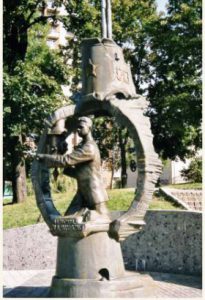
memorial at palmnicken
Memorial at Palmnicken, Kaliningrad Oblast, Russia

Warning: This, sadly, is a true story of incredible cruelty that you will not be able to get easily out of your mind once you have read it. It is one of many similar  acts of unimaginable savagery making up the holocaust and perpetrated by the criminal leadership of the German Nazi Reich during its dying days. Once they realized that their game was up and that the end of the Reich was in sight, they embarked on a desperate attempt to erase the evidence of their state run genocide directed against the Jews of Europe. This would include closing existing concentration camps, by evacuating prisoners to other areas, to be killed  and their bodies disposed of.

It was this approach to the Final Solution – Endlösung – that saw approximately 7,000 people, mostly Jewish women – begin their death march on 26 January 1945 from their Königsberg prison in East Prussia towards the town of Palmnicken in the Samland region on the Baltic coast. They had been gathered from various areas in Eastern Europe, and their death march to Palmnicken would be one of many similar marches by Jewish prisoners in East Prussia from January 1945 onwards.

Palmnicken was approximately 50 kilometers away. Once they arrived there, the plan was to drive the prisoners into a disused mine shaft in the large amber mine complex at the shore front, and then to seal up the entrance.

The march started the late morning of January 26 under the most atrocious conditions. It was the midst of a very cold winter, and the prisoners went without food or warm clothes. One survivor, Maria Blitz (née Salz) (1), recalled:

We were wrapped in dirty, threadbare blankets and on our feet we wore crude wooden clogs, which made moving forward on the snow and ice—in addition to our constant mortal terror—pure torture. Our clothing consisted of rags and paper, which we had tied together with wires to protect ourselves from the cold. Anyone who could not go on or fell over was shot immediately or beaten with a rifle butt. My sister Gita could not go any further—she had violent diarrhea and collapsed. We tried to get her back on her feet, but she asked us to leave her lying there, she wanted to go to her mother—whom we had already lost in Auschwitz. She was shot.

A Königsberg resident who witnessed the start of the march, Rose-Marie Blask, remembered the following:

I was 14-years-old back then. … I saw a procession of people on the other side of General-Litzmann-Strasse [the former Fuchsberger Allee]. I stood near a tree, it was already getting dark, the air full of snow, and no one could see me. Then I saw in horror that the SS were driving a long procession of prisoners in front of them. Again and again, an SS man raised his arm and a person fell in the snow, though I could not hear a gunshot. I don’t know how long I stood there, as if frozen. At any rate, I saw a lorry following on behind. The dead were lifted out of the snow and thrown into the back of the lorry.

Only 3,000 of the approximately 6,500 to 7,000 Jewish prisoners arrived in Palmnicken later that night on January 26. Around 2,000 to 2,500 marchers where either shot by the accompanying SS guards when they tried to flee or simply fell down, or died from sheer exhaustion during the 50 kilometer march under abhorrent conditions. The following morning up to 300 corpses were found along the final two kilometer stretch between Palmnicken and the village of Sorgenau.
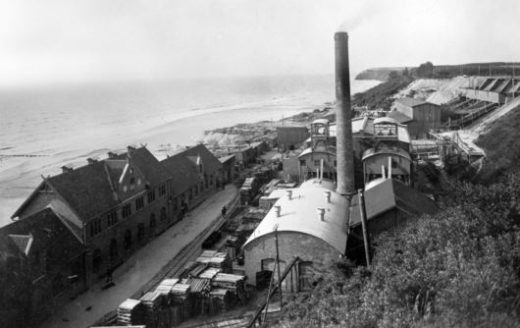
The Anna Grube

Once at the mine site in Palmnicken things did not go to plan for the SS as the site manager refused to allow the disused shaft – the Anna Grube – to be used for mass murder. It was argued that the shaft was needed for the town’s water supply. Instead, the remaining exhausted and freezing victims were allowed to recover from their ordeal by being housed in the mine’s large workshop, and the factory canteen was order to cook for them. On January 30th, however, the site’s estate manager – Hans Feyerabend – was found dead, his own gun in his mouth, but unclear if he had committed suicide or was murdered. He had opposed the SS plans to murder all the prisoners from the moment he found out about it.

That same evening a number of Hitler Youths were ordered by the town’s mayor and the regional Nazi Party group leader to assist the SS at the disused Anna mine site with re-captured Jewish prisoners who had managed to get away during the final stage of the march. One of the Hitler Youths, Martin Bergau – on which much of this account is based – stated the following:

When we left the municipal office with the SS-men, it was already quite dark. … When we reached the northern part of the town, we turned left and went down the path to the closed Anna mine. We reached the squalid buildings, situated at sea level. I noticed a group of around forty to fifty women and girls. They were captured Jews. A diffuse source of light sparsely illuminated what seemed a ghostly scene. The women had to line up in twos, and we were instructed by the SS-men to escort them. Around six to eight SS-men might have belonged to the command. I could not tell whether they were Germans or foreigners, as their commands were extremely terse. Once the line-up was complete, two women at a time were led around the side of the building by two SS-men. Shortly afterwards two pistol shots rang out. That was the sign for two more SS executioners to take the next two victims to the building, which was shrouded in twilight, and shots soon resounded there again. I had had to position myself pretty much at the end of the long line. A classmate stood right across from me with a cocked rifle, watching over the women on the other side. One woman turned to me and asked in good German if she could move two places forward; she wished to walk this last path with her daughter. In a voice nearly choked with tears, I granted this brave woman her request. … Then I accompanied a mother whom I will never forget to her daughter.

Because of the concerns about contaminating the town’s water supply, the SS opted for a different approach. With the promise that the prisoners would now be taken by ship to Hamburg, they were led out of the main complex and through a gate that led directly onto the beach where they were directed to start marching South towards along the icy Baltic seashore towards Pilau. Once on the way, the SS executed their plan kill each and every one of the roughly 3,000 remaining prisoners, by machine-gunning the marchers from the back and herding them into the icy waters. Because of the melee that followed – and the sheer number of prisoners involved – the SS could not murder everyone as systematically as they had planned. Many victims were initially only wounded, or not even hit. Some fainted and froze to death, or became trapped between ice floes and drowned. Others died on the beach after days in agony. But some survived;  Zila Manielewicz, born in 1921 in Ozorkow, recalled the following:

When we arrived on the shore, it was already darkest night. … Suddenly I was hit on my head with a rifle butt and I and I fell into a precipice. I gained consciousness in the water. At this time, dusk had already fallen. The shore was full of corpses and the SS men were still hovering over them. …. Towards morning the SS men disappeared. Around this time we became aware that about 200 of us were still alive. We got up and climbed onto the beach. The path we had taken that night was itself full of corpses and the seawater was red from the victims’ blood. Together with two other Jewish women, I dragged myself to the closest German village; …

Another account, by Pnina Kronisch,born in 1927 in Belzec:

Then they threw the murdered Jews into the water by kicking them. As the seacoast was covered with ice, the murderers pushed their victims into the icy water with their rifle butts. Since I was at the front of the column with my sister Sara, we were the last in line to be shot. I was also laid down on the seacoast together with my sister, though I was not killed by the shot that was aimed at me but only wounded in my left foot, and my face was soaked in the blood of the murdered Jews lying next to me. During this time my sister was killed. I did not wait until the Germans threw me into the sea—I threw myself in and remained lying next to the ice floe, which already was caught up in the water and hit by the waves. The Germans believed I was dead, and since I was alone, to my good luck, and last in line to be murdered, the Germans got into their sleds and drove off. Before dawn I scrambled out of the sea and hid in the coal store of a German farmer who did not live far from where these events occurred.

Because the seashore where the massacre occurred was separated by a broad strip of park and woodland and the town 30 meters above, only a few of the inhabitants of Palmnicken saw what happened that night. But next day it was immediately apparent that a massacre had taken place. Helene Zimmer, a former resident of Palmnicken, stated the following to the Ludwigsburg court:

… Then we went back to Palmnicken on foot, along the shore instead of along the completely congested road. It was a very painful march taking several hours. … Just before Palmnicken, actually between Nodems and Palmnicken, we suddenly saw countless corpses lying on the shore, and also heard desperate screams still coming from the water. As far as I could see, those lying on the shore were all dead, and every now and then we could hear desperate cries coming from the water. … The water along the shore was partly frozen and ice floes floated around, between them were the seriously wounded or dead people. Many of them were dressed in the same striped clothes. There were also many women among them. … I was so shaken at the sight that I covered my eyes with my hands. … We then quickly went on walking because we could not stand the sight.

It is estimated that approximately fifteen of the original group of 7,000 individuals survived death march and final massacre on the beach at Palmnicken. While the crime was reported to the Soviets when they captured Palmnicken ten weeks later, few details regarding this monstrous crime made its way into the West prior to 1994. It was then that Martin Bergau – a former Hitler Youth member from Palmnicken- had his memoir covering the war years published. He had witnessed the crime at the age of sixteen. Shortly after the massacre he had been taken prisoner by the Soviets; after his release he had not been allowed to return to his home in East Prussia.

In 1945 Palmnicken became part of the Soviet Union and Königsberg was renamed Kaliningrad as a result of the Potsdam agreement. After the Soviet Union’s collapse in 1992 it became part of the Russian Federation. While the mass grave in the Anna mine had disappeared into a sand dune, the murder victims’ remains were eventually unearthed by amber excavators in the 60’s. Initially thought to be the remains of Soviet soldiers murdered by the Germans, a memorial stone was erected and wreaths were laid every year at the site until the demise of the Soviet Union in 1992. Finally, in 1994, Martin Bergau was able to convince the regional authorities that the bodies lying at the site were in fact Jewish.

And so ends another incredibly sad tale of man’s inhumanity to man – what an infinitely tragic species we are! Clearly, there can be no almighty god, or at least not one that is capable of compassion, empathy, love or self-respect – and in which case he might as well kill himself. Or perhaps he did that already, realizing what kind of creature he hath wrought here on earth, as we must have started slaughtering each other from the moment we found ourselves capable of it.

Today is January 27 2017, Yom HaShoah, or International Holocaust Remembrance Day.
Lest we forget …

This post is based on:
Endlösung on the ‘Amber Shore’:
The Massacre in January 1945 on the Baltic Seashore—
A Repressed Chapter of East Prussian History
BY ANDREAS KOSSERT (2004)
http://leobaeck.oxfordjournals.org/

maria-blitz
Maria Blitz

(1) Maria Blitz – one of the last survivors of the the Palmnicken Massacre in January of 1945 died on June 11, 2016, at the age of 98.

Welcome to 2017, “The Year of the Idiot”

On some great and glorious day the plain folks of the land will reach their heart’s desire at last, and the White House will be adorned by a downright moron. (H. L. Mencken, 1880-1956)

Given the subject matter I am addressing today the flavour of this post can’t help but be more appropriately in tune with the cantankerous creature that I am naturally, and more comfortably, from myself.

Hitherto I have always attempted to present a range of rational arguments that were meant to be -if anything – food for thought in a world that appeared to be sliding into a soul crushing display of idiocy, to the point of self-destruction.

And what a fool I am – a Don Quixote of  mediocre intelligence, astonishing naivety and brazen assumptions about the nature of the world and all that can be found in it – in being so wrong about the depth of despair the world appears to have sunk to!

Just so we know where I stand on this, I find the world and all that can be found in it a place of incredible beauty and wonder, but then only if we were able to subtract that horrible insipid creature homo sapiens from its inventory, including all its dastardly deeds since the beginning of time. Other than that, I consider it an absolute privilege to be a part of it. Speaking of the true meaning of “a chance of a lifetime”, but, oh, how we are squandering this opportunity!

I look forward to soon being able to get back to writing about my foolish yet  guardedly  optimistic assumptions about the meaning and nature of the larger world. But before I get there I want to metaphorically throw up  some of the indigestible misery that I am forced to ingest much too frequently,  by being exposed to the actions of my fellow creatures, thanks – but no thanks, really – to the tragic but inescapable fact of being a member of the same sorrowful species.

So let me throw this one up large, as it has been sticking in my craw for some time: how could there have been enough  US citizens of eligible voting age to elect a moron of the magnitude of a Donald Trump to be their next president?

This is either a case of severe voter fraud, or there is in fact some truth to the rumour that many  Americans have been changed into zombies. The latter would be true given that even with half-a-brain it should have been clear that this self-aggrandizing individual is no presidential material anywhere,  unless we’re talking about marginal countries such as North Korea or Zimbabwe – hellholes of human misery by any other name – where  leadership  appears to be mainly a function of intimidation and bullying, requiring no intellectual capacity at all.

The absolute tragedy now is that it appears that the folks who can least afford to have a  windbag and pathological narcissist like Trump at the helm of their country have in fact given him the keys to to the White House: this is tantamount to the chickens electing Colonel Sanders to look after their interest. They have jumped from the frying pan directly into the fire, when – by “draining the swamp” of Wall Street lobbyist – he is now putting Wall Street kingpins directly into government. As reported by Forbes the other day:

… Trump announced Gary Cohn (who was seen as the successor to Goldman’s current chief executive Lloyd Blankfein) will be joining his cabinet as director of the National Economic Council and an assistant to the President for economic policy. Cohn’s appointment means there will be a trifecta of former Goldmanites in the Trump administration. Former Goldman partner and mortgage trader Steven Mnuchin has been named Secretary of Treasury by Trump. Steve Bannon, a former Goldman banker, is his chief strategist.

How confused can you get, America?  Your government will be run directly by the sharks raised and educated at Goldman Sachs, predatory capitalism’s finest specimens. Guided by the motto “To Take from the Many to Give to the Few”, these  are the folks that get up in the morning for the sole reason to stuff their own pockets  – and those of their cronies – with other peoples money, and by hook or by crook it seems.

They are the very miscreants that precipitated the September 2008 financial crisis that almost brought down the world’s financial system.  They did this by selling sub-prime mortgage derivatives out of the front door, touting them as the fines investment instruments ever, while shorting these stinkers through the back door, knowing full-well they were absolute garbage to begin with. How low can you go?  And: NOBODY WENT TO JAIL FOR THIS!

It took a huge taxpayer-financed bailout to shore up the financial industry. Even so, the ensuing credit crunch turned what was already a nasty downturn into the worst recession in 80 years. To think that these types of characters would now switch their allegiance from their own pocketbooks to Joe Six-pack – and in particular the under- or unemployed and destitute – is a stretch only attempted by anyone even more naive than I am.

Excuse me now while I look for some mouthwash to get the sour taste out of my mouth.

The Scourge of Mankind

One continues to wonder why anyone would be willing to kill a fellow human being just because they don’t share your religious beliefs.  But for any student of European history it is not too difficult to be reminded of such acts of barbarism being committed in the name of deity of sorts, when murder was on the repertoire in order to advance the interests of the Roman Catholic Church in Europe during the Dark or Early Middle Ages

Lest we forget, by slaughtering the infidel unwilling to convert to their version of Islam, the Muslim Jihadis of today appear to have taken a page from the late great King Charlemagne – or Charles the Great – the king of the Franks, who became the first emperor in Western Europe since the collapse of the Western Roman Empire and is sometimes referred to as the founder of modern Europe.

During his campaign to establish an empire in full support of the Church, he felt compelled to Christianize newly conquered people upon penalty of death, which lead to such events as the massacre of 4,500 captive rebel Saxons in October of 782 in what is now known as Verden in Lower Saxony, Germany. The unfortunate Saxons had rebelled against King Charles’ invasion and his subsequent attempts to Christianize them from their native Germanic paganism.

And that massacre pales in comparison with the events almost 500 years later, in 1209, in the town of Béziers in the Languedoc region.  When the Roman Catholic Church established the Inquisition, it was set up initially to wipe out the Cathar movement in southern France where it had taken hold in opposition to the hitherto dominant Roman Catholic religion. Apparently, there were a lot of Cathars living in the town of Béziers, to the point that it was seen to be a Cathar stronghold, and on July 22nd, 1209, under leadership of the Abbot of Citeaux the town was attacked, ransacked, and completely burned to the ground, the majority of its population of 20,000 people killed, including many women and children. That this would have included many thousands of Roman Catholic adherents who were also living in Béziers didn’t seem to matter. When questioned about this, the Cistercian abbot-commander of the Catholic crusaders, is on record of having said that: “Caedite eos. Novit enim Dominus qui sunt eis. (Kill them all, the Lord will recognize His own).

Now all this happened a long time ago, and while today the Christian faith is far more benign,  the justification for this kind of slaughter remains an intrinsic part of the foundation of the Christian faith: the bible, for in Deuteronomy XIII.12-16, the faithful are instructed as follows:

If thou shalt hear say in one of these cities …, Let us go and serve other Gods …; then shalt thou surely smite the inhabitants of that city with the edge of the sword, destroying it utterly and all that is therein. … And thou shalt burn with fire the city and all the spoil thereof every whit for the Lord thy God. … And it shall be a heap forever; and it shall not be built again.

And so we are here today, 800 years after the slaughter in Béziers – and yes, it was rebuilt again! –  and in the 21st century, and as can be evidenced from recent events in the Middle East, innocent people continue to be slaughtered in the name of some god or prophet or another. One might claim that this kind of action has nothing to do with the religious beliefs themselves – and that they are misused when wielded as weapons of murder and destruction. No – it is precisely the unsubstantiated and irrational nature of these beliefs that allows them to be used in this manner. When you think you have the creator and eternity on your side – all your actions are justified; you cannot be wrong!  Until we shake off the influence of these dangerous nonsensical beliefs, our species will continue to be murdered for them.

This leads me to say that to believe in the existence of a god or other kinds of super-natural beings has historically shown itself to be a seemingly endless source of human tragedy. Because – while in principle these are nonsensical and hence harmless beliefs– it is at the same time the sickly smell of centuries of savagery and senseless slaughter of thousands  of people in the name of such beliefs – and primarily in the competition between such beliefs.

Mars

On October 12 of 2016 U.S. President Barack Obama vowed to help send people to Mars within the next 15 years, pledging to work with private companies “to build new habitats that can sustain and transport astronauts on long-duration missions in deep space.”

Earlier this year,  SpaceX founder and all-around wunderkind Elon Musk of Tesla fame outlined his highly ambitious vision for manned missions to Mars, which he said could begin as soon as 2022 – three years sooner than his previous estimates. And, never short on vision, he envisages 1 million people living there by 2060 (presumably all going to the local shopping malls in electric vehicles)

And back in March of 2012, Dutchman Bas Lansdorp announced The Mars One project to establish a human settlement on Mars in 2023, and as such the effort is portrayed as “the next giant leap for humankind”. Other than that, the one catch is that this project does currently not include a way to leap back to earth from there …

The most amazing thing of the Mars One project is that – when the word went out that they were looking for volunteers for a one way trip to Mars – people have been lining up to be part of this mission.  “The trip of a lifetime” said one volunteer that made the shortlist. Well, yes, and “likely the very last trip of a lifetime” might also be an accurate description of it.

To be sure, Mr. Lansdorp does not plan to make the trip himself. He will be occupied by the production of a reality TV show that is meant to finance the project as it will feature his Mars-bound flock as they get on with the business of colonizing the dusty red planet.

The Sun sets on Mars

Now, why in the world would anyone want to go to a place like Mars – also known as a dead planet? It was author and visionary Ray Bradbury (1920-2012) who – in The Martian Chronicles – made the colonization of Mars becomes a necessity for human survival – with humans fleeing a troubled, broken and atomically devastated home planet Earth.  But unless someone knows something that I don’t know, the last time I looked, this incredibly beautiful planet of our is still very much alive,  and most of it very habitable, and although there are many among us who are doing their best to put a stop to that, with a little bit of foresight and determination we will be able to put a stop to them sooner rather than later to ensure it remains habitable for the foreseeable future.

It is said that exploring the solar system as a united humanity will bring us all closer together. Mars is the stepping stone of the human race on its voyage into the universe. Human settlement on Mars will aid our understanding of the origins of the solar system, the origins of life and “our place in the universe”.

Now I would not want to make light of any of these lofty objectives, but there is a kind of charming naivety about these projects that makes me question the depth of the brain trust behind them. While “Getting there is half the fun!” or so it is said, there are some significant issues to be concerned about before strapping yourself into a tin can for a lengthy journey into the unknown, and this regardless of the fact that – as in the Mars One project – you will only have a one-way ticket for this trip (!)

Recent research into the effects of long-term space-travel suggests that cosmic radiation from the remnants of supernovae could pose cognitive risks for astronauts on long journeys. Researchers from Arizona State University exposed rodents to space-like levels of radiation for six weeks and observed significant cognitive damage. The rodents performed badly on memory and learning tests, and showed elevated levels of anxiety. Six months later, the rodents were still suffering from neural damage. The conclusion is that cosmic radiation breaks down the structural complexity of neurons in the brain’s pre-frontal cortex, which is associated complex cognitive behaviour like decision making. Researcher Dr. Charles Limoli, a professor of radiation oncology at the University of California Irvine’s School of Medicine compared it to stripping the branches off a tree.

“It may impact the ability of astronauts to undertake multitasking, executive function, decision-making, or respond to unanticipated events,” he said.

And  while one is cocooned in a space capsule for a seven month trip through a vacuum,  as well as having one’s brain vacuumed out by cosmic radiation, I wonder about the intrepid Mars-bound traveler ability to realize that that our place in the universe is the very planet they just left, the one that that spawned us, nurtured and continues to sustain us provided we continue to care for it.

The fact is that, today, it has become possible to reach out and touch the stars remotely with the help of some very clever technology, and allowing us to do so from within the comfort and safety of our own planet’s environment. There is no aspect of Mars – or the universe at large, for that matter – that, in principle, cannot be discovered or examined remotely and without having to go there physically. This as opposed to having to drag our critical life-sustaining environment along with us when we do this  in person.  Now why do I suddenly have this image of a goldfish in a zip-lock bag filled with water …

It seems to me that putting all our resources towards the advancement of remote technologies for space-exploration will be a significant less costly way to realize our goals for spacial exploration, let alone not having to put people’s lives in jeopardy, which should be the very first consideration for not wanting to fire folks into in infinite vacuum on the head of a rocket.  Really, how desperate can you get?

Alright, so where is my sense of adventure – and don’t I have any imagination at all? From my very early days as a teenager I have been collecting science fiction literature by just about any who could inspire me on that matter, and that includes Isaac Asimov, Ray Bradbury, Arthur C. Clark, Robert Heinlein, Larry Niven, Jerry Pournelle and even cranky Vonnegut – and many, many others – and not forgetting Jules Verne, who’s writings introduced me to the genre a long time ago.

As well, you name the science fiction movie or TV production made recently or in the past, and I will likely have seen it, including Le Voyage dans la Lune from 1902. And yes, of course the Matt Damon movie “The Martian”.  Add to that all the TV series such as Star Trek, Space:1999, FarScape, Firefly, etc, and without question most of it very entertaining, if not always very believable!

So what does this have to do with  the utility of manned space exploration?  What I  have picked up from this is that the tales of science fiction are metaphors for exploring the human mind, in terms of considering alternate realities within the limits of our understanding of what we are and what we are all about.  Such considerations also project our existing technologies into the future to get a glimpse of what they ultimately might lead to. And what better way to put them into the hands of some aliens, who, as different they may be from an appearance point of view, are often decidedly more human than most in emphasizing certain human character traits  – in particular in the department of predation, conquest, domination, violence and destruction.

On that subject, I have always wondered why is it that aliens are typically out to destroy us or take our planet. I think this is because we have a deep-seated fear that we might in fact loose the earth to some evil alternate version of ourselves – now or in the future.  By invoking the latter as aliens we can fight and kill them in a virtual reality game without feeling guilty about ourselves, having essentially disowned such threats through a process of self-denial, i.e., no human being could ever be that self-destructive.

None of this will have anything to do with setting up human colonies on lifeless planets such as Mars or other dead rocks such as the Moon. There, I only smell money, the usual target of predatory capitalism, ready to ransack another heavenly body,  and as far removed from the romantic notion of “exploring the solar system” as you can get.

Though I’m past one hundred thousand miles,
I’m feeling very still
And I think my spaceship knows which way to go
Tell my wife I love her very much, she knows
Ground control to major Tom, your circuits dead,
There’s something wrong
Can you hear me, major Tom?
Can you…
Here am I floatin’ ’round my tin can far above the world
Planet Earth is blue and there’s nothing I can do.
(from “Space Oddity”, on the 1969 David Bowie album)

Dreams

‘Our birth is but a sleep and forgetting:
The Soul, that rises with us, our life’s star,
Hath had elsewhere its setting,
And cometh from afar.’ (William Wordsworth)

There are some who believe that reality is but  a dream in which we are awake, and as much as it would be difficult to get your head around that notion, it does remind me about dreams and their sometimes uncanny ability to play certain episodes in your life back to you.

When you happen to remember such dreams, you realize soon that what is important about them is the theme as well as the role you played in them, and that it is the nature of the actions and their relationships that are the significant part; everything else in them is likely incidental, to provide a setting for the theme, just like the props used in a staged theater play, conveniently borrowed from the vast store of your experiences so that you are able to relate to what is being presented to you.

In this context we can look at dreams as allegorical reflections of real-life experiences that have affected you in some way, their meaning embedded in a seemingly different set of circumstances. As such they are emotional echoes, resonating certain events in your life back to you, because they had some significance in the way they effected you although you might not have thought so at the time.

I think that, similarly, life will generate experiences for us that can be seen as being allegorical to the extent that they reflect indirectly what motivates us directly from within, below the surface of our consciousness, by the entity that we are from ourselves and the embodiment of an evolutionary drive of unknown origin and intent.

This is saying also that we didn’t come to the table with a blank slate – everything that has gone into the making of us is represented within us – how could it not be? Whatever process brought us about – we call it evolution – propels us towards a destiny we are yet to create for ourselves, but unable to articulate much or any of this we find ourselves acting out what is at stake by our very presence in it.

Religion

The suggestion that the human race is lost and absolutely hapless when it comes to understanding their place in the world has been expressed many times. In the mid  1600’s the Dutch philosopher Baruch Spinoza wrote that people find themselves with needs and desires without understanding the reasons why they want and act as they do.  Lacking this knowledge about themselves and their place in the world creates the illusion that they can do as they please, and which is a source of much grief in the world when they act against their own interest because they simply don’t know any better.

And when it comes to that, I’m sure we will all agree that more than a little guidance is required to prevent the human race from finding new ways to harm itself.  As even primitive ape colonies appear to have hierarchies and moral codes to govern their members interaction,  it was likely in the interest of self-preservation that our ancestors came up with the idea to legitimize their tribal laws and institutions by invoking authorization from a higher source, e.g., a deity of sorts. This could be (at one time)  the sun-god Ra, the King of all Gods and mortals, or further varieties on that theme, unseen yet almighty entities with a supposed interest to keep us on the straight and narrow, and that we better do as we’re told, or else there would be hell to pay! And heaven would be our reward …

Enter religion – and until the eventual uncoupling of Church and State –  the self-proclaimed owners of whatever moral framework was seen as being necessary for a society to function with some degree of success towards a tenable future.  I know I have simplified this premise greatly, but it merely introduces the idea that religion is  about placing the seat of moral authority off-planet and hence beyond the ability to scrutinize it, question it or challenge it.

Of course, the problem was that not everyone one had the same idea about this, and so religious conflict was born. While this notion of  all-powerful metaphysical  beings helped to stabilize our species at the individual tribal level for certain periods of time,  it also appears to have been one of the main reasons for people to slaughter each other in order to establish the primacy of their particular brand of religious beliefs.

Regarding the latter, it is the nature of religious beliefs to be unsubstantiated, and examining them is like peeling an onion: after stripping layer after layer there is absolutely nothing at their core. Although some folks simply claim that they “know” that such beliefs are absolutely true – e.g., that a God exists – we can do little but take their word for it as they are unable to clarify what they mean by this assumption. This is at the core of every religious edifice – rationality has no place here – and as Nietzsche put it once  “Faith means not wanting to know the truth”.

Without a doubt religion has confused a lot of people into various stages of existential despair, the inevitable outcome of trying to believe in something that is entirely without substance regardless of what spiritual or ontological argument one wishes to root for it.  The attempt to make the leap of faith required in order to embrace some variety of eschatological mythology at the core of existence leaves one stranded at the dark abyss of irrationally because all reason must be abandoned beforehand.

Religion has no future, only a deadly present and a deadly past – it is the poisonous worm that, in the abandonment of reason, burrows itself deeply into the minds of those who find comfort in the kinds of beliefs that appear to let them off the hook for having to take any kind of responsibility for the moral character of our species, as this will have been decided “elsewhere”.  This reminds me of a line from a poem by Nietzsche’s favourite poet Holderlin which,  loosely translated from German, goes something like this: “While here on earth we mortals toil, elsewhere a God decides …”

Truly, in today’s language, God is vaporware, and at most an unsubstantiated rumour. But while the belief in imaginary entities might be deemed a juvenile condition by any other name, collectively our species should have grown out of this by now, and in the process have prepared the intellect to be immune from similar afflictions. This as we attempt to extract ourselves from the quagmire of religious superstition into a more enlightened future free from the self-denial featured by such beliefs. Hopefully we will then want to embrace the idea that we are accountable for our all our actions to ourselves only, and not to some entirely imaginary third party.

The Largest Maritime Disaster in History

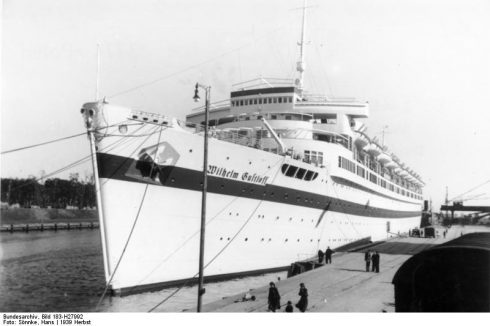
On the 30th of January, 1945,  the Soviet submarine S-13 attacked and sank the MV Wilhelm Gustloff in the Baltic sea with as many as 10,000 refugees on board, and in so doing caused the largest maritime disaster in recorded history.

The 208 meter liner was being used to evacuate civilians and military personnel from East Prussia. Of the estimated more than 10,000 mostly women and children, elderly men and including about 1,200 navy sailors, only very few – 1,252, to be precise – made it off the steamer alive. Three Soviet torpedoes had hit the ship within an hour; the temperature outside was minus 18 degrees Celsius.

On January 12th, the Soviet army had broken through on three fronts, and by the 26th they reached the eastern shore of the Gulf of Danzig. This effectively cut Prussia off from the rest of Germany, and from that moment the only escape could be by sea.

mv-wilhelm gustloff
MS Wilhelm Gustloff

At around 9 p.m. on January 30, 1945 in the packed dining hall of the luxury liner Wilhelm Gustloff, as in most of the rest of the country, a radio was broadcasting an address by Hitler but the thousands of refugees from Pomerania and East and West Prussia who had struggled onto the ship weren’t listening to the Führer now as they wanted only one thing – to be rescued!

The solace offered by the Wilhelm Gustloff was enormous for the passengers who boarded the ship at Gotenhafen. Hundreds of thousands of German civilians had wanted to embark on ship in the port near Gdansk, in what is today Poland. The Red Army was on their heels and their thoughts were of Nemmersdorf. It was the first village in German territory reached by the Soviets and rumours were circulating of the draconian revenge on the part of the Soviets for German war crimes. Only the navy could rescue them now.

At 208 meters (680 feet), the Gustloff wasn’t the largest ship used to transport wounded soldiers and civilians. But it was by far the most well known. It was the Nazis’ luxury liner, christened by none other than Hitler in 1937. Its name came from a killed Nazi officer, and it was initially reserved for high-ranking National Socialists to take vacations in the Mediterranean or along the western Norwegian coastline. By the end of the war, however, the ship had taken on an entirely different role – for its last journey.

The civilian escape via the Baltic Sea belongs to one the most impressive chapters in German WWII military history. Historians have estimated that around 2.5 million people were rescued by ship out of the German eastern zones. The Wilhelm Gustloff was just one of dozens of ships used in the Baltic rescue operation. Its tragic end wasn’t inevitable, experts have contended, singling out three fatal decisions as responsible for the disaster.

Firstly, there was no convoy to offer protection, and since the ship carrying some 1,000 soldiers was intended to reach Kiel as quickly as possible, there was also no flank protection.  A small torpedo boat was all the protection the ship was given.  And since sea mines were feared along the Baltic coast, the planned route was to traverse the open sea. Finally, since the Gustloff hadn’t been used in over four years, Captain Wilhelm Peterson only dared a speed of 12 knots, instead of the possible 15.

These three factors contributed to what would become a death sentence for most of the ship’s passengers. If the ship had been  escorted by a convoy and  provided with flank protection, and travelled at a faster speed, experts have said the Soviet submarine S-13 would never have been able to hit the Wilhelm Gustloff with its torpedoes.

Seven decades on, some details of the disaster still remain a mystery, however. Was sabotage to blame when a suspicious radio message warning of sea mines reached the command bridge, just before the first torpedo hit? In order to avoid a collision amid heavy snowfall, Captain Peterson had turned on the ship’s position lights: 90 minutes with bright lighting, but no minesweepers. The Gustloff was a sitting duck.

There is much to support the theory that German POWs – “turned by the Soviets” and positioned behind enemy lines via parachutes – were behind the false reports. For Heinz Schön, that is a horrible thought. He was 18 years old at the time, onboard the Gustloff as an aspiring naval pay clerk. Although he was one of the very few survivors, he is reticent to call the sinking of the Gustloff a war crime. It was ultimately carrying soldiers, sailing under enemy colors and armed. The firing of the torpedoes in no way contravened martial law. (*)

The Statue of Alexander Marinesko in Kaliningrad

For most of the war, the Nazis had kept the Soviet fleet bottled up in the Russian port city of Kronshtadt located on Kotlin Island, 30 kilometers west of Saint Petersburg, by a blockade and by mining the Gulf of Finland. But after the Russo-Finnish armistice on September 19, 1944 the agreement awarded the Russians important military bases on Finnish territory, including the strategic Hangö peninsula.

On the morning of 11 January 1945 the 780-ton Soviet sub S-13 under the command of  Submarine commander Alexander Marinesko left the Hangö harbour at the entrance to the Gulf of Finland  to take position near Kolberg on January 13.

While in the first few days his submarine was attacked several times by German torpedo boats, during nineteen days at sea he encountered only civilian small craft in the frigid waters off Lithuania.

He received radio dispatches from his home port describing the fall of Memel (present-day Klaipeda, Lithuania) and Königsberg so he reasoned that naval transports might be evacuating troops to the west. Hugging the coastline, he saw no activity where he expected it most, but on 30 January 1945 Sub-13 attacked and sank the Wilhelm Gustloff.

Days later, on 10 February, Marinesko sank a second German ship with two torpedoes, the Steuben, carrying mostly military personnel, with an estimated total number of 4,267 casualties. Marinesko thus became the most successful Soviet submarine commander in terms of gross register tonnage (GRT) sunk, with 42,000 GRT to his name.

Before sinking the Wilhelm Gustloff, Alexander Marinesko was facing a court martial due to his problems with alcohol and was thus deemed “not suitable to be a hero”. He was instead awarded the Order of the Red Banner. Although widely recognized as a brilliant commander, he was downgraded in rank to lieutenant and dishonourably discharged from the navy in October 1945.

In 1960 he was reinstated as captain third class and granted a full pension. In 1963 Marinesko was given the traditional ceremony due to a captain upon his successful return from a mission. He died three weeks later on 25 November 1963 from cancer, and was buried at the Bogoslovskoye cemetery in St. Petersburg. Marinesko was posthumously awarded Hero of the Soviet Union by Mikhail Gorbachev in 1990 after rehabilitation by newspaper Izvestia.

(*) Segments of this account are based on a Deutsche Welle (DW) article of Jan 30, 2015)

Religion Kills Once Again

It was reported by the BBC today that a Bangladeshi publisher of secular books has been hacked to death in the capital Dhaka in the second attack of its kind on Saturday, police say.  Faisal Arefin Dipon, 43, was killed at his office in the city centre, hours after another publisher and two secular writers were injured in an attack.

They are the latest victims in a series of deadly attacks on secularists since blogger Avijit Roy was hacked to death by suspected Islamists in February. Both publishers published Roy’s work.

While it would definitely be wrong to put all Islamists in the same fanatical and bloodthirsty category, it nevertheless says something about the nature of this religion when it is able to incite some its followers  to such barbaric and murderous measures in order to defend their faith.

I seem to recall that Nietzsche said once that “morality is a function of a herd’s instinct to self-preservation”  and clearly, the Muslim herd feels under threat here,  and is resorting to deadly measures   to defend itself against attacks based on reason and critical thought.

Presumably, this demonstrates once again the necessity for certain religious beliefs to be based on fear as opposed to having a foundation in truth, if only because there is none to be found.

Religious Zombies

Zombies are undead creatures, typically depicted as mindless, reanimated human corpses with a hunger for human flesh (Wikipedia)

Zombies are purported to be mythical creatures – nevertheless there is  abundant evidence that they exists, but then more so as religious zombies, by sharing some of the same qualities as mentioned in the definition above.

The specific qualities I have in mind are, firstly,  the apparent mindlessness of zombies as evidenced by the inability of religious individuals to think for themselves or avail themselves of reason when it comes to the credibility of their religious beliefs, which – like all religious beliefs –  cannot be substantiated in any way, shape or form except by other religious beliefs. Examining these beliefs is like peeling an onion; in the end you will find nothing at its core. Religion is our biggest failure as a sentient and supposedly advanced species.

Secondly, as observed in the most severe and debilitating cases of religious zombie-ism – a pathological thirst for the blood of those who dare to disagree or subject to them, be they man, woman or child. Here it should be clear that I am referring to the infestation of the murderous Jihadists in the Middle East – a human pestilence of the worst kind, and a cause worth of the most severe kind of eradication! Only total extermination will do here so none will be left to kill the innocent or contaminate the feeble minded among us with this deadly plague of murder and mayhem. The fanatical Jihadists are the clearest evidence of the potential deadliness of runaway religious beliefs that are allowed to fester outside the reach of reason and beyond just plain old common sense.

A blight on mankind by any other name would be as deadly, and a wooden stake through the hearts of all of them so they will never ever have a chance to rise up again!

WWII – Liberation Day

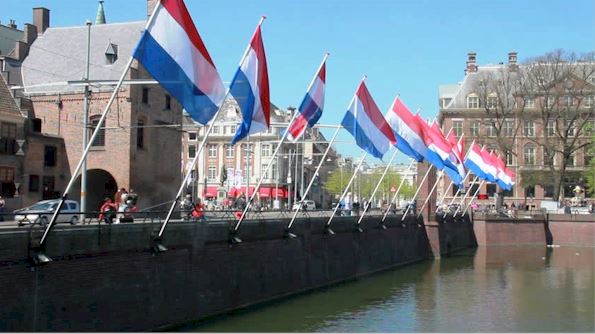
Liberation Day - The Netherlands
Liberation Day – The Netherlands

Today, May 5th, is National Liberation Day in the Netherlands  to commemorate the capitulation of the Nazi forces in that country exactly 70 years ago on May 5, 1945. It is a national holiday, although not a statutory day off and employers are allowed to work this out between themselves and their employees.

As someone born in the Netherlands at the beginning of  WWII I remain deeply grateful for the fact that Americans and Canadians came over to slay the evil Nazi beast and set us free. Many of them gave their lives for this. This surely was a case of a just war, wasn’t it: the grim and sadistic Nazi machine had to be stopped and sent back down the gates of hell from whence it came, goose-stepping and all. So many innocent people died as a result of this war, on both sides.

It wasn’t until much later that I heard about the Allied bombing of civilian targets, and in particular the firebombing of the city of Dresden when the Nazi Reich was already well on its knees, with the Germans surrendering less than a month later on May 7, 1945,  following Adolf Hitler’s suicide and  the Soviet troops conquering Berlin.

On the night of February 13, the British Bomber Command hit Dresden with an 800-bomber air raid, dropping some 2,700 tons of bombs, including large numbers of incendiaries. Aided by weather conditions, a firestorm developed, incinerating tens of thousands of people. The temperature of the masonry in the city’s cathedral reached an estimated 1,000 Celsius.  Reports speak of many victims melting in the intense heat, their bodies becoming welded to pavements. The U.S. Eighth Air Force followed the next day with another 400 tons of bombs and carried out yet another raid by 210 bombers on February 15. (*)

The Dead of Dresden

It is thought that some 25,000–35,000 civilians died in Dresden in the air attacks, though some estimates are as high as 250,000, given the influx of undocumented refugees that had fled to Dresden from the Eastern Front, primarily from Silesia and on the run from Stalin and the Red Army. Most of the victims were women, children, and the elderly.

Dresden was just one of a number of German cities that were targets of aerial bombing raids as Hamburg and Königsberg suffered similar fates. However, the seemingly indiscriminate large-scale area bombing of civilian populations remained controversial throughout WWII. Winston Churchill went so far as to write “The destruction of Dresden remains a serious query against the conduct of Allied bombing.” While there were legitimate military targets in Dresden, how can one sanction the deliberate targeting of the civilian population?”

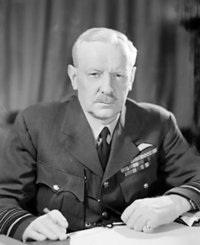
arthur-bomber-harris
Arthur “Bomber” Harris

The British air attacks were conducted under the leadership of Air Officer Commander-in-Chief Arthur “Bomber” Harris, and when questioned about his preference for area bombing over precision targeting  given the large number of civilian casualties and wide-scale destruction the strategy caused he is reported to have said:

“It should be emphasized that the destruction of houses, public utilities, transport and lives, the creation of a refugee problem on an unprecedented scale, and the breakdown of morale both at home and at the battle fronts by fear of extended and intensified bombing, are accepted and intended aims of our bombing policy. They are not by-products of attempts to hit factories”. (RAF Air Chief Marshal Arthur Harris, October, 1943) (**)

The issue was raised within the British House of Lords on Wednesday February 9th of 1944, when it was pointed out that this practice would have been contrary to International Law, as per the 1922 Washington Conference on Limitation of Armaments proposed code for Aerial Warfare.

While this code did not become an international convention, nevertheless great weight should be attached to article 22nd drawn up by a Commission of International Jurists: “Aerial bombardment for the purpose of terrorizing the civilian population, of destroying or damaging property not of military character, or of injuring non-combatants is prohibited”. As well, Article 24 stated: Aerial bombardment is legitimate only when directed at a military objective.

In this this context the British historian Frederic Taylor said that , while it was true that Dresden as a major German industrial and military centre was a legitimate target for the Allied Forces to go after, “When we think of Dresden, we wrestle with the limits of what is permissible, even in the best of causes.”

(*) In describing the RAF bombing of Dresden and other German cities during WWII, I wish to make it absolutely clear that anyone who gave their life in WWII to eradicate the criminal Nazi regime deserves our deepest appreciation, and their acts of bravery and self-sacrifice should never be forgotten. And this includes the thousands of US and British airmen who were ordered to perform incredible feats of courage,  by flying nearly blind for hours and hours in the dark across hostile territory and aided by relatively limited navigational aids – at least by today’s standards)

(**)  In defending his role in the fire-bombing of Dresden Harris wrote that “… the attack on Dresden was at the time considered a military necessity by much more important people than myself.” Bomber Command’s crews were denied a separate campaign medal (despite being eligible for the Air Crew Europe Star and France and Germany Star) and, in protest at this establishment snub to his men, Harris refused a peerage in 1946; he was the sole commander-in-chief not to become a peer. However, in February 1953 Winston Churchill, now prime minister again, insisted that Harris accept a baronetcy and he became baronet.