‘Our birth is but a sleep and forgetting:
The Soul, that rises with us, our life’s star,
Hath had elsewhere its setting,
And cometh from afar.’ (William Wordsworth)
There are some who believe that reality is but a dream in which we are awake, and as much as it would be difficult to get your head around that notion, it does remind me about dreams and their sometimes uncanny ability to play certain episodes in your life back to you.
When you happen to remember such dreams, you realize soon that what is important about them is the theme as well as the role you played in them, and that it is the nature of the actions and their relationships that are the significant part; everything else in them is likely incidental, to provide a setting for the theme, just like the props used in a staged theater play, conveniently borrowed from the vast store of your experiences so that you are able to relate to what is being presented to you.
In this context we can look at dreams as allegorical reflections of real-life experiences that have affected you in some way, their meaning embedded in a seemingly different set of circumstances. As such they are emotional echoes, resonating certain events in your life back to you, because they had some significance in the way they effected you although you might not have thought so at the time.
I think that, similarly, life will generate experiences for us that can be seen as being allegorical to the extent that they reflect indirectly what motivates us directly from within, below the surface of our consciousness, by the entity that we are from ourselves and the embodiment of an evolutionary drive of unknown origin and intent.
This is saying also that we didn’t come to the table with a blank slate – everything that has gone into the making of us is represented within us – how could it not be? Whatever process brought us about – we call it evolution – propels us towards a destiny we are yet to create for ourselves, but unable to articulate much or any of this we find ourselves acting out what is at stake by our very presence in it.
The suggestion that the human race is lost and absolutely hapless when it comes to understanding their place in the world has been expressed many times. In the mid 1600’s the Dutch philosopher Baruch Spinoza wrote that people find themselves with needs and desires without understanding the reasons why they want and act as they do. Lacking this knowledge about themselves and their place in the world creates the illusion that they can do as they please, and which is a source of much grief in the world when they act against their own interest because they simply don’t know any better.
And when it comes to that, I’m sure we will all agree that more than a little guidance is required to prevent the human race from finding new ways to harm itself. As even primitive ape colonies appear to have hierarchies and moral codes to govern their members interaction, it was likely in the interest of self-preservation that our ancestors came up with the idea to legitimize their tribal laws and institutions by invoking authorization from a higher source, e.g., a deity of sorts. This could be (at one time) the sun-god Ra, the King of all Gods and mortals, or further varieties on that theme, unseen yet almighty entities with a supposed interest to keep us on the straight and narrow, and that we better do as we’re told, or else there would be hell to pay! And heaven would be our reward …
Enter religion – and until the eventual uncoupling of Church and State – the self-proclaimed owners of whatever moral framework was seen as being necessary for a society to function with some degree of success towards a tenable future. I know I have simplified this premise greatly, but it merely introduces the idea that religion is about placing the seat of moral authority off-planet and hence beyond the ability to scrutinize it, question it or challenge it.
Of course, the problem was that not everyone one had the same idea about this, and so religious conflict was born. While this notion of all-powerful metaphysical beings helped to stabilize our species at the individual tribal level for certain periods of time, it also appears to have been one of the main reasons for people to slaughter each other in order to establish the primacy of their particular brand of religious beliefs.
Regarding the latter, it is the nature of religious beliefs to be unsubstantiated, and examining them is like peeling an onion: after stripping layer after layer there is absolutely nothing at their core. Although some folks simply claim that they “know” that such beliefs are absolutely true – e.g., that a God exists – we can do little but take their word for it as they are unable to clarify what they mean by this assumption. This is at the core of every religious edifice – rationality has no place here – and as Nietzsche put it once “Faith means not wanting to know the truth”.
Without a doubt religion has confused a lot of people into various stages of existential despair, the inevitable outcome of trying to believe in something that is entirely without substance regardless of what spiritual or ontological argument one wishes to root for it. The attempt to make the leap of faith required in order to embrace some variety of eschatological mythology at the core of existence leaves one stranded at the dark abyss of irrationally because all reason must be abandoned beforehand.
Religion has no future, only a deadly present and a deadly past – it is the poisonous worm that, in the abandonment of reason, burrows itself deeply into the minds of those who find comfort in the kinds of beliefs that appear to let them off the hook for having to take any kind of responsibility for the moral character of our species, as this will have been decided “elsewhere”. This reminds me of a line from a poem by Nietzsche’s favourite poet Holderlin which, loosely translated from German, goes something like this: “While here on earth we mortals toil, elsewhere a God decides …”
Truly, in today’s language, God is vaporware, and at most an unsubstantiated rumour. But while the belief in imaginary entities might be deemed a juvenile condition by any other name, collectively our species should have grown out of this by now, and in the process have prepared the intellect to be immune from similar afflictions. This as we attempt to extract ourselves from the quagmire of religious superstition into a more enlightened future free from the self-denial featured by such beliefs. Hopefully we will then want to embrace the idea that we are accountable for our all our actions to ourselves only, and not to some entirely imaginary third party.
Much of what I am trying to do here is to get to the story behind the story, i.e., to get a glimpse of the greater context of what plays itself out every day as what we refer to as “life” or “living”. It is based on the assumption there must be more to life than what I, you or for that matter anyone else might have experienced in a lifetime, regardless of what that may have included.
So what would be the grounds for such assumption when I seem to say that the basis for it is outside life’s experiential realm? To get a sense of what I’m hinting at is a little bit like what the character Morpheus says to Thomas A. Anderson, AKA “Neo” and the protagonist in the excellent 1999 Sci-Fi movie Matrix: You’ve felt it your entire life, that there’s something wrong with the world.
Now I realize that this might be an understatement for some, but here I’m not talking about all the really bad things that are happening in the world today (and have more or less always happened in the world of yesterday) and an astonishing human tragedy by any other name given all the calamities, war, religious strife, murder and mayhem and what have you, but the fact that regardless of the nature of the event – good or bad – it remains a mystery why any of it actually needs to take place, i.e., what in the world is playing itself out here?
In short, I am saying that life, living, doesn’t add up … at least not for me, and while that might just be my problem, I think not. I suggest we are seeing only part of the script here.
This has to do with the fact that you cannot make sense of something existing for its own sake. I know, some will say something equally nonsensical, like “it is what it is”, but trying to make sense of apparent nonsense is one of my interests, especially when there appears to be so much of it, such as a whole universe of it.
So when I say that it doesn’t add up, I mean to say that I have never come across the reason as to why we are here, on this planet, in this universe, or the reasons why life is the way it is to the extent that we are challenged by it on a daily basis.
Sure, science will give you a hand full of reasons as to why the world is the way it is, but these are descriptive accounts that assume the world as a given without any further justification for it being there in the first place. When it comes to life, similarly – and discounting religious nonsense of any kind – the answer to the question “why are we here” is lacking also.
And so, in whatever way you look at it, the world – life – appears to be more of a solution in search of a problem, i.e., we don’t have the whole story. And unless there is something more going on than what meets the eye, i.e., what we must confront on a daily basis, the world and everything that can be found in it appears to make no sense at all. At least not for the present …
The basic inorganic building blocks from which life was formed are chemicals such as methane, ammonia, water, hydrogen sulphide and carbon dioxide, and likely a few more. To date no credible scientific theory has been advanced that can account for the process that results in the configuration of these basic materials to exhibit a form of life.
While a precise definition of ‘life’ continues to be up for debate, I’m going with the statement that something is alive when it demonstrates at least some innate capacity to interact with its environment in a manner that goes beyond mere cause and effect as a function of the laws of physics. The ability to replicate – as essential it is to the continuation of life today would not be essential to the definition; the earliest living molecules may have been generated continuously for thousands of years in the earliest stages of Earth’s biosphere before the capacity for self-replication came about. My main point here is to discuss the emergence of animate matter – life – from what appeared to be inanimate matter, leaving us with the question as to what precise process was responsible for this.
Given a basic living system of sorts – e.g., a simple amoeba, a single cell organism – and subtract from it all the known material elements we can discern within it, so that nothing will be left over, we will not come across the property – at least not one that has been detected – that would account for the amoeba being alive. Other than the conclusion that we must have missed something in the analysis, the suggestion has been made that – in addition to the presence of critical material elements – identified as the building blocks of life – the appearance of life as an emergent property is strictly a function of how its material constituents are organized and able to interact with each other. A state of organizational integrity capable of expressing itself as a living organism, but we have no clue as to what the critical organizational element consist of or how it gets implemented.
Rejecting heavenly intervention (I know, a necessary assumption for some, but I am only interested in rational, non self-serving explanations) the questions remains how a given combination of material compounds is able to assume a life-exhibiting configuration and continue to persist as such. The conclusion must be that matter must have an innate capacity to be organized in this manner, leading to yet another mystery: how does this capacity -or at least the potential for it – reside in matter? In a sense it is similar to the innate potential for atoms to combine with other atoms into molecules of the various elements, as described by the laws of physics. Seemingly, biology extends these laws into the next level of higher organizational complexity, allowing life to appear.
At which point is the potential for life already present in matter? The conclusion seems to be that this potential is found within the most elementary forms of matter, and that as matter evolves into ever more complex patterns of organizational persistence the capacity for life exhibiting behaviour increases in the case of compounds we have come to associate with being essential to the expression of life within matter.
Finally, the conclusion seems inescapable that the potential for life resides within even the most elementary particle in the world. If this is true, the cosmos as a whole should be looked at as a living organism even in its most elementary innate or inanimate form, potentially capable of expressing itself into the myriad of life-forms that we are already familiar with, and that would include our own.
… But Trailing Clouds Of Glory Do We Come, From God, who is our home: Heaven lies about us in our infancy!” (William Wordsworth)
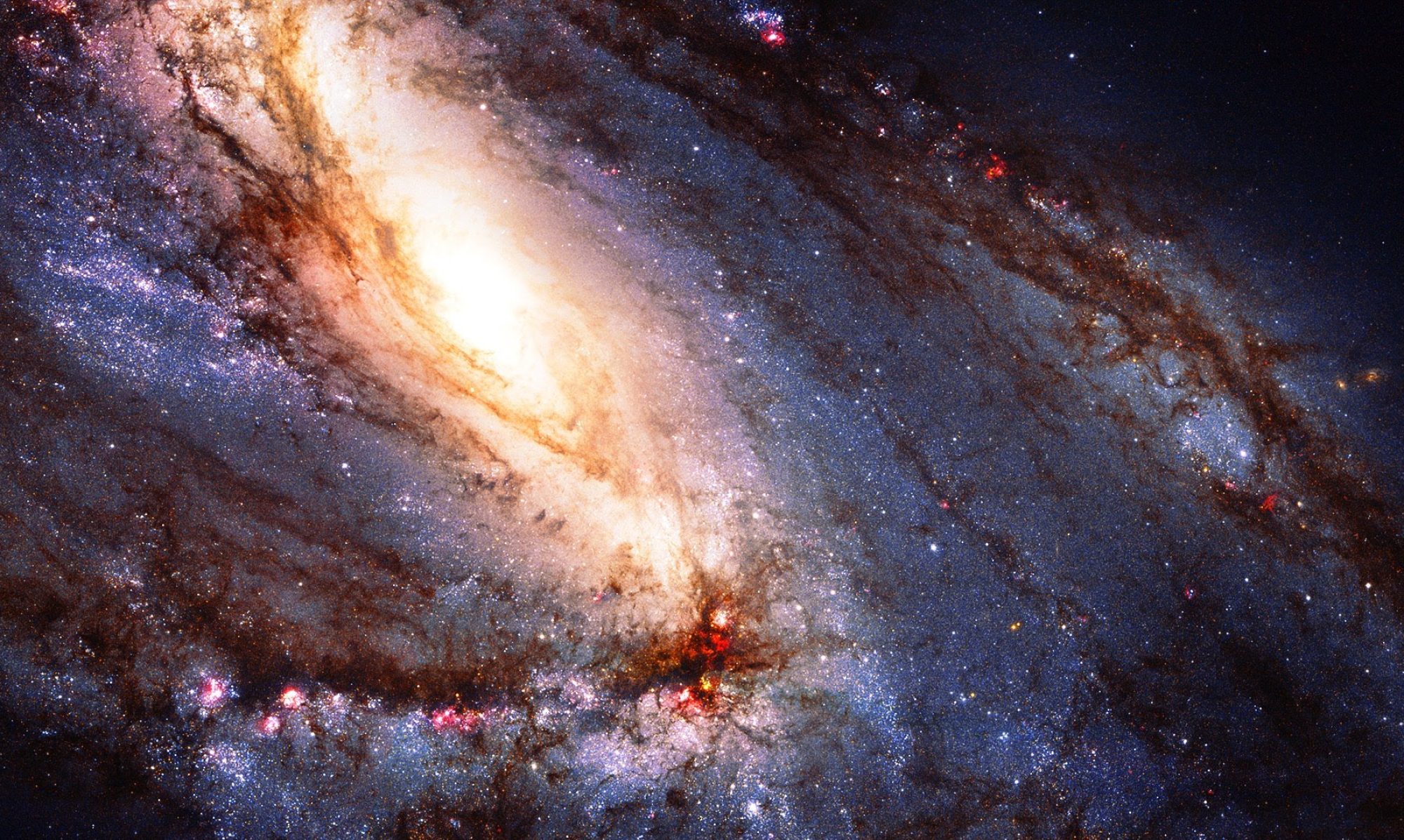
Apart from the obligatory nod to the prevailing local deity at the time that this was written, that is exactly where we came from – and, of course – where we still are! The cosmic womb that spawned us, and that continues to nurture us! And so let’s focus for a moment on the ongoing scientific effort to probe the heavens – our heavenly home – with the hope of finding out more about its origin and scope – such as how all of this might have come about.
And as we continue to do so – by reaching out further and further into the depths of the physical universe with VLTs (Very Large Telescopes) – whatever we want to conclude about our cosmic environment becomes less and less intelligible the further we move away from earth. And here I couldn’t agree more with what was once said by Pierre Teilhard de Chardin, a Jesuit paleontologist, in 1923 in Letters from a Traveler “The more remote in time and space is the world we confront, the less it exists, and hence the more barren and poorer it is for our thoughts”.
Ask yourself this: how meaningful is the recent discovery of the oldest galaxy ever observed by the Hubble telescope: “It is thought the galaxy is more than 13 billion years old and existed 480 million years after the Big Bang.”
Or: “Astronomers have spotted the most distant object yet confirmed in the universe – a self-destructing star that exploded 13.1 billion light years from Earth. It detonated just 630 million years after the big bang, around the end of the cosmic “dark ages”, when the first stars and galaxies were lighting up space”.
Apart from the “wow!” factor, this kind of information says more about the technology that made these discoveries possible than the actual objects themselves. While we may be able to express these observations in a manner that suggests that we actually know what we are talking about, we have clearly no concept of what this means beyond building a theoretical model of our universe in which we appear to be just another speck of dust.
At most we can conclude is that an event is being played out here of cosmic dimensions, but also that – as unlikely as this may seem – this incredible spectacle is directly relevant to us, as it pertains to both our origin, and our destiny. Yes, gentle reader, all this cosmic commotion is about you, regardless of whether you want to accept that or not.
I want to suggest that we can talk about the cosmos in a more meaningful fashion, by accepting all of it as another dimension of ourselves. And here I am not talking about some esoteric physical and (above all) theoretical dimension requiring a succession of half-a-dozen blackboards to get spelled out, and meaningful only to some other theoretical physicist working within the same Kuhnian paradigm. With due respect, no. I want to suggest an aspect of the cosmos that connects every particle internally regardless of where it is located – or how it is configured – and constitutes its integrity as an phenomenon in all its perplexing detail.
And while we do not know or understand much or any of it, it is an intrinsic part of our own existence, meaning that the key to all its magical and mysterious secrets lies not out there in some distant and abstract corner of outer space, but within ourselves. We embody all of this within the entity that we are: its origin, its history, its present scope, and its destiny.
Much of our scientific probing of outer space reminds me of a cat that got itself locked in a closet, scratching around in the dark trying to find a way out. But we’re not trapped here, in the sense of being an isolated event in the cosmos: we are an event of the cosmos, and so we don’t need to find a way out, we’re home safe and sound!
And so I am suggesting the possibility that, on the evolutionary front, we are its leading event – with the history of all that preceded us behind us, and a future in front of us to decide and create! With the arrival of our species – Homo Faber – the spectacular creativity power inherent in the evolutionary process that brought us about is now able to work directly through us for whatever goals we set for ourselves now or in the future!
I have been led to conclude that, if the cosmos is about anything at all, its agenda is about reinventing itself as a new entity, by turning itself inside out – so to speak – through the process of evolution, and reconstituting itself as the sum of all the power and creativity that it is capable of. You could say that it is a question of “rising to the occasion”, and as participants in this process this is something that we are all challenged with on a daily basis: we all have the same agenda, namely to make something of ourselves that captures our true potential.
And so we, the simple creatures of the earth, are finding ourselves at the top of creation as defined by our emerging consciousness, to be challenged to look deeper within ourselves to enable our own advancement as a species, to be more creative, more empowered, and to be more enlightened to take on our fate as an agent of evolution.
Presumably, all this to bring about a better world while seemingly still preoccupied by the instincts of the predatory animal that once preceded us – but in many way is still within us – as evidenced by the dystopia we’re stumbling around in today and which appears to be entirely of our own making.
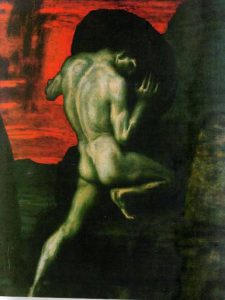
Sisyphus, as we know, is the figure in Greek mythology who was punished by the local Gods for his deceitfulness by being forced to roll an immense boulder up a hill, only for it to roll down again at the top, forcing him to repeat this action for eternity.
In The Myth of Sisyphus published in 1942 French author and Nobel laureate Albert Camus retells the tale of Sisyphus as likening the futility of his labours to the human condition, the point being that all human endeavours are essentially meaningless in a cold and indifferent universe.
Camus concludes that it is absurd to continually seek meaning in life when there is none, and that it is equally absurd to try to know, understand, or explain the world when no rational knowledge can be obtained from it. While accepting absurdity as the mood of the times, Camus appears most interested in the question of whether or how to live in the face of it.
But there is a problem this line of reasoning, and not only on just logical grounds. Firstly, we can’t exclude the possibility that there is in fact a meaning and purpose to the universe just because we can’t see the point of it.
Secondly, it makes no sense to say that we cannot obtain rational knowledge of the world given the multitude of verifiable scientific successes that have occupied themselves with the material nature of the world. This includes the discovery of evolution as a means to provide perspective to the phenomenon that live represents as well as the context for where we are in the in the hierarchy of all things living.
And by linking our biological ancestry to the heart of the material universe through the process of evolution, science has attached us more firmly to the world.
This leads me to believe that the universe has a plan, and within it lies the larger context for all human endeavours, as we find ourselves at the receiving end of it. For many this larger context simply may not exist or is merely taken for granted, its relevancy subsumed in the background noise of every day life.
Other than that, yes, the story the greater universe may have to tell is definitely something of interest to science, but by and large their observations and subsequent theories put it so far out of reach of everyday life that it is difficult to see how much of it has any bearing on the way we conduct our lives.
One might presume that merely living our lives provides us with all the meaning and context we find ourselves preoccupied with at a given moment. But that might only be the case so long as we don’t look beyond the immediacy of the current moment and try to place it within the larger reality of the surrounding universe. And just because it is seemingly so grand and perplexing that we can’t possibly get our heads around it, it is nevertheless part and parcel of who and what we are, yet have absolutely no clue what we all of this means.
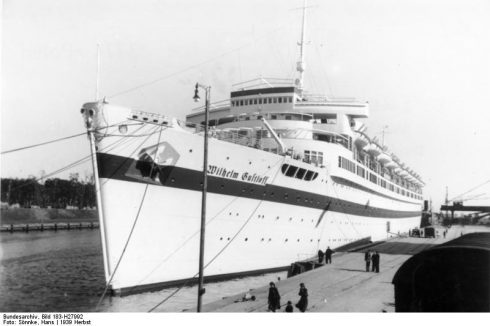
On the 30th of January, 1945, the Soviet submarine S-13 attacked and sank the MV Wilhelm Gustloff in the Baltic sea with as many as 10,000 refugees on board, and in so doing caused the largest maritime disaster in recorded history.
The 208 meter liner was being used to evacuate civilians and military personnel from East Prussia. Of the estimated more than 10,000 mostly women and children, elderly men and including about 1,200 navy sailors, only very few – 1,252, to be precise – made it off the steamer alive. Three Soviet torpedoes had hit the ship within an hour; the temperature outside was minus 18 degrees Celsius.
On January 12th, the Soviet army had broken through on three fronts, and by the 26th they reached the eastern shore of the Gulf of Danzig. This effectively cut Prussia off from the rest of Germany, and from that moment the only escape could be by sea.
MS Wilhelm Gustloff
At around 9 p.m. on January 30, 1945 in the packed dining hall of the luxury liner Wilhelm Gustloff, as in most of the rest of the country, a radio was broadcasting an address by Hitler but the thousands of refugees from Pomerania and East and West Prussia who had struggled onto the ship weren’t listening to the Führer now as they wanted only one thing – to be rescued!
The solace offered by the Wilhelm Gustloff was enormous for the passengers who boarded the ship at Gotenhafen. Hundreds of thousands of German civilians had wanted to embark on ship in the port near Gdansk, in what is today Poland. The Red Army was on their heels and their thoughts were of Nemmersdorf. It was the first village in German territory reached by the Soviets and rumours were circulating of the draconian revenge on the part of the Soviets for German war crimes. Only the navy could rescue them now.
At 208 meters (680 feet), the Gustloff wasn’t the largest ship used to transport wounded soldiers and civilians. But it was by far the most well known. It was the Nazis’ luxury liner, christened by none other than Hitler in 1937. Its name came from a killed Nazi officer, and it was initially reserved for high-ranking National Socialists to take vacations in the Mediterranean or along the western Norwegian coastline. By the end of the war, however, the ship had taken on an entirely different role – for its last journey.
The civilian escape via the Baltic Sea belongs to one the most impressive chapters in German WWII military history. Historians have estimated that around 2.5 million people were rescued by ship out of the German eastern zones. The Wilhelm Gustloff was just one of dozens of ships used in the Baltic rescue operation. Its tragic end wasn’t inevitable, experts have contended, singling out three fatal decisions as responsible for the disaster.
Firstly, there was no convoy to offer protection, and since the ship carrying some 1,000 soldiers was intended to reach Kiel as quickly as possible, there was also no flank protection. A small torpedo boat was all the protection the ship was given. And since sea mines were feared along the Baltic coast, the planned route was to traverse the open sea. Finally, since the Gustloff hadn’t been used in over four years, Captain Wilhelm Peterson only dared a speed of 12 knots, instead of the possible 15.
These three factors contributed to what would become a death sentence for most of the ship’s passengers. If the ship had been escorted by a convoy and provided with flank protection, and travelled at a faster speed, experts have said the Soviet submarine S-13 would never have been able to hit the Wilhelm Gustloff with its torpedoes.
Seven decades on, some details of the disaster still remain a mystery, however. Was sabotage to blame when a suspicious radio message warning of sea mines reached the command bridge, just before the first torpedo hit? In order to avoid a collision amid heavy snowfall, Captain Peterson had turned on the ship’s position lights: 90 minutes with bright lighting, but no minesweepers. The Gustloff was a sitting duck.
There is much to support the theory that German POWs – “turned by the Soviets” and positioned behind enemy lines via parachutes – were behind the false reports. For Heinz Schön, that is a horrible thought. He was 18 years old at the time, onboard the Gustloff as an aspiring naval pay clerk. Although he was one of the very few survivors, he is reticent to call the sinking of the Gustloff a war crime. It was ultimately carrying soldiers, sailing under enemy colors and armed. The firing of the torpedoes in no way contravened martial law. (*)
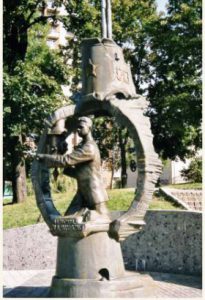
The Statue of Alexander Marinesko in Kaliningrad
For most of the war, the Nazis had kept the Soviet fleet bottled up in the Russian port city of Kronshtadt located on Kotlin Island, 30 kilometers west of Saint Petersburg, by a blockade and by mining the Gulf of Finland. But after the Russo-Finnish armistice on September 19, 1944 the agreement awarded the Russians important military bases on Finnish territory, including the strategic Hangö peninsula.
On the morning of 11 January 1945 the 780-ton Soviet sub S-13 under the command of Submarine commander Alexander Marinesko left the Hangö harbour at the entrance to the Gulf of Finland to take position near Kolberg on January 13.
While in the first few days his submarine was attacked several times by German torpedo boats, during nineteen days at sea he encountered only civilian small craft in the frigid waters off Lithuania.
He received radio dispatches from his home port describing the fall of Memel (present-day Klaipeda, Lithuania) and Königsberg so he reasoned that naval transports might be evacuating troops to the west. Hugging the coastline, he saw no activity where he expected it most, but on 30 January 1945 Sub-13 attacked and sank the Wilhelm Gustloff.
Days later, on 10 February, Marinesko sank a second German ship with two torpedoes, the Steuben, carrying mostly military personnel, with an estimated total number of 4,267 casualties. Marinesko thus became the most successful Soviet submarine commander in terms of gross register tonnage (GRT) sunk, with 42,000 GRT to his name.
Before sinking the Wilhelm Gustloff, Alexander Marinesko was facing a court martial due to his problems with alcohol and was thus deemed “not suitable to be a hero”. He was instead awarded the Order of the Red Banner. Although widely recognized as a brilliant commander, he was downgraded in rank to lieutenant and dishonourably discharged from the navy in October 1945.
In 1960 he was reinstated as captain third class and granted a full pension. In 1963 Marinesko was given the traditional ceremony due to a captain upon his successful return from a mission. He died three weeks later on 25 November 1963 from cancer, and was buried at the Bogoslovskoye cemetery in St. Petersburg. Marinesko was posthumously awarded Hero of the Soviet Union by Mikhail Gorbachev in 1990 after rehabilitation by newspaper Izvestia.
(*) Segments of this account are based on a Deutsche Welle (DW) article of Jan 30, 2015)
It was reported by the BBC today that a Bangladeshi publisher of secular books has been hacked to death in the capital Dhaka in the second attack of its kind on Saturday, police say. Faisal Arefin Dipon, 43, was killed at his office in the city centre, hours after another publisher and two secular writers were injured in an attack.
They are the latest victims in a series of deadly attacks on secularists since blogger Avijit Roy was hacked to death by suspected Islamists in February. Both publishers published Roy’s work.
While it would definitely be wrong to put all Islamists in the same fanatical and bloodthirsty category, it nevertheless says something about the nature of this religion when it is able to incite some its followers to such barbaric and murderous measures in order to defend their faith.
I seem to recall that Nietzsche said once that “morality is a function of a herd’s instinct to self-preservation” and clearly, the Muslim herd feels under threat here, and is resorting to deadly measures to defend itself against attacks based on reason and critical thought.
Presumably, this demonstrates once again the necessity for certain religious beliefs to be based on fear as opposed to having a foundation in truth, if only because there is none to be found.
“Nothing is an object unless there is a subject to consider it.” While not questioning the existence of objects when not directly considered, in “The World as Idea”, Arthur Schopenhauer (1788-1860) says that we only know the world in relation to ourselves, to the extent that we are conscious of it. There is no independent verification of the fact that things, objects in the world, the world itself -are in fact what we perceive them to be.
This introduces an important distinction into the discussion, namely, (a) the object, and (b) the knowledge we have of it based on our perception of it. We can make this distinction on the basis that, if we have knowledge of an object, it presupposes the existence of it, and that its existence is a function of the way it exists in the world through its various attributes, e.g., attributes related to its spatial dimensions, shape, color, etc., and that it has these attributes regardless of anyone being able to perceive them or not.
Consider that our perception of objects is, in the first instance, a function of two things. Firstly, an object being the causal element in the act of perceiving it, and secondly, the ability of our perceptual apparatus to process the sensory information in a manner that is assumed to be reliable in being able to reproduce the object accurately as a discernible event in one’s stream of consciousness. The latter would form the basis on which variable degrees of knowledge of the object can be formulated, depending on the quality and nature of the experience, and whatever else might have been know about the object prior to the particular perception of it at a given moment in time.
The latter is relevant as there are going to be differences between perceived objects on the basis that we may already have beliefs about them. In short, people sometimes see what they want to see, or are expecting to see. On this topic Nietzsche said in 1887:
As soon as we see a new image, we immediately construct it with the aid of all our previous experiences, depending on the degree of our honesty and justice. All experiences are moral experiences, even in the realm of sense perception.
This is a whole topic on its own, and we won’t go there just now, but it is just another reminder that our perception of objects might be suspect when it comes to their accuracy. But for the current exercise we’ll proceed on the premise that sensory perception is by and large a reliable enterprise, and see where it will get us.
Having said that, there is in fact some manipulation going on by the time the object arrives in our stream of consciousness as a perceptual event. Before it arrives there, it will have been processed by our brain’s neural network on the basis of the nature of the data received from the sensory organs (eyes, ears, etc.) and – as I inferred earlier – we give this process the benefit of the doubt in being able to reproduce the object exactly as it was presented to us at the moment of perception. As much as the act of perceiving is entirely transparent to the perceiver such that it would appear we have direct access to the object, I’m merely stating this as a reminder that, in fact, we do not, as we are always one step removed from it.
Finally, in addition to there being a neurological process to convert objects being perceived into mental objects in one’s stream of consciousness, human beings – as all other creatures that live on earth – will have had their sensory organs evolved to the degree that this was necessary for them to survive as a species. As such we can point to significant differences between species in how objects are perceived in terms of their properties. Think about the highly developed sense of smell that a dog has versus what the average human nose is able to detect. When faced with the same object, this would produce a different object for the perceiver with respect to at least one of its properties. To a lesser degree there are going to be (however subtle) differences between the perceived version of the same objects between humans on the basis of their individual physiologies.
So the question for us here is: Regardless of the degree of knowledge we have of an object – e.g., we only know some of its properties, do we have any reason to believe that objects in the world are in fact not what we perceive them to be? What else could they be other than what we perceive them to be? Does anyone care? Why do philosophers worry about this? Philosophers such as Immanuel Kant (1724-1804) introduce such concepts as the “thing-in-itself” (“ding ansich”) to suggest that the true nature of things in the world is fundamentally unknowable as we can only grasp the nature of things indirectly through perceiving them as objects in relation to ourselves – how we have experienced them. As I attempted to point out earlier, our knowledge of the world is – so to speak – tainted by human perception, i.e., as Nietzsche says, there is no immaculate perception.
Let it suffice that (a) objects exist regardless of anyone having any knowledge of them, and (b) if we do have knowledge of an object, it would be reasonable to assume that it exist as perceived, but that (c) we will never know that it exist exactly in the manner in which we believe its exists – as that level of knowledge is simply not available to us as it cannot be verified outside the act of perception.
This leads me to conclude that – while we can make the distinction I made earlier – between (a) an object, and (b) the knowledge we have of that object, it is in fact a logical distinction as well as an ontological distinction, and that to all intents and purposes the knowledge we have of an object is in fact knowledge of its mental replica we carry around in our stream of consciousness , and that – as such – the subject defines the object to the extent that this is the only way an object is available to the subject.
So now I would be tempted to say that, whatever knowledge we have of the physical world and derived through the senses (is there any other way?), this knowledge may not be entirely truthful with respect to what it is telling you about the world and everything in it. This is what French Philosopher Rene Descartes (1596-1650) concluded about the reliability of sensory experiences:
Whatever I have accepted until now as most true has come to me through my senses. But occasionally I have found that they have deceived me, and it is unwise to trust completely those who have deceived us even once.
Now “deceived” is a strong word – implying an intentionally malicious act – and I would have preferred to say that discrepancies might occur between (a) the object being perceived and (b) our perceptual apparatus being able to reproduce it accurately as a mental object in the stream of consciousness. Such is the nature of reality.
(I’m leaving some other problems alone here, e.g., in philosophy 101 we should have all learned that you cannot deduce a cause from an effect – that to do so is a logical fallacy. In the movie The Matrix they made that work by placing hapless human minds at the receiving end of a causal chain that made them interact with objects in a virtual reality that was entirely software generated. So, again, even if you have a mental construct of an object in your consciousness, there is no guarantee that it does in fact exist in the world in the manner that you believe it to be, and you may only have been led to believe that it was there.)
Life is a metaphor and living it tells us what the cosmos is all about. The problem is, we don’t really know what is going on, but are forced to act out what is at stake here by our very presence in it. Look around you: are we bewildered, or what?
But make no mistake about this: we are the cosmos – every single atom in it is represented in our being and embody its greatest accomplishment, the capacity for reflection and rational thought. Unfortunately – in the case of the latter – we still have a lot to overcome, such as religion by any other name.
And make no mistake about this either: Religion will destroy us if we don’t keep it in check, and to allow itself to burn out due to the lack of substance at its core, e.g., what is happening to Christianity today. There, for all intents and purposes, God is dead, although many still cower in his fading shadow as they continue to partake in its empty rituals. But for the other religions – such as manifested by the primitive, tribal and sometimes deadly Muslim hordes – they must be kept at bay by all means possible.
Clearly, the weapon of choice must be education, to allow for the development of critical thought by the individual. Only then can we all take part in the debate about what this cosmic metaphor is all about, and begin to live life to its full potential, free from suffocating self-denying religious dogma and the vestiges of a superstitious past that has held us back way to long.
 Lost Planet