Life

The basic inorganic building blocks from which life was formed are chemicals such as methane, ammonia, water, hydrogen sulphide and carbon dioxide, and likely a few more. To date no credible scientific theory has been advanced that can account for the process that results in the configuration of these basic materials to exhibit a form of life.

While a precise definition of ‘life’ continues to be up for debate, I’m going with the statement that something is alive when it demonstrates at least some innate capacity to interact with its environment in a manner that goes beyond mere cause and effect as a function of the laws of physics. The ability to replicate – as essential it is to the continuation of life today would not be essential to the definition; the earliest living molecules may have been generated continuously for  thousands of years in the earliest stages of Earth’s biosphere before the capacity for self-replication came about.  My main point here is to discuss the emergence of animate matter – life – from what appeared to be inanimate matter, leaving us with the question as to what precise process was responsible for this.

Given a basic living system of sorts – e.g., a simple amoeba, a single cell organism – and subtract from it all the known material elements we can discern within it, so that nothing will be left over, we will not come across the property  – at least not one that has been detected – that would account for the amoeba being alive.  Other than the conclusion that we  must have missed something in the analysis,  the suggestion has been made that – in addition to the presence of critical material elements – identified as the building blocks of life – the appearance of life as an emergent property is strictly a function of how its material constituents are organized and able to interact with each other. A state of organizational integrity capable of expressing itself as a living organism, but we have no clue as to what the critical organizational element consist of or how it gets implemented.

Rejecting heavenly intervention (I know, a necessary assumption for some, but I am only interested in rational, non self-serving explanations) the questions remains how a given combination of material compounds is able to  assume a life-exhibiting configuration and continue to persist as such.  The conclusion must be that matter must have an innate capacity to be organized in this manner, leading to yet another mystery: how does this capacity -or at least the potential for it – reside in matter?  In a sense it is similar to the  innate potential for atoms to combine with other atoms into molecules of the various elements,  as described by the laws of physics. Seemingly,  biology extends these laws into the next level of higher organizational complexity, allowing life to appear.

At which point is the potential for life already present in matter?  The conclusion seems to be that this potential is found within the most elementary forms of matter, and that as matter evolves into ever more complex patterns of organizational persistence the capacity for life exhibiting behaviour increases in the case of compounds we have come to associate with being essential to the expression of life within matter.

Finally, the conclusion seems inescapable that the potential for life resides within even the most elementary particle in the world. If this is true, the cosmos as a whole should be looked at as a living organism even in its most elementary innate or inanimate form, potentially capable of expressing itself into the myriad of life-forms that we are already familiar with, and that would include our own.
Our Heavenly Home

… But Trailing Clouds Of Glory Do We Come, From God, who is our home: Heaven lies about us in our infancy!”  (William Wordsworth)

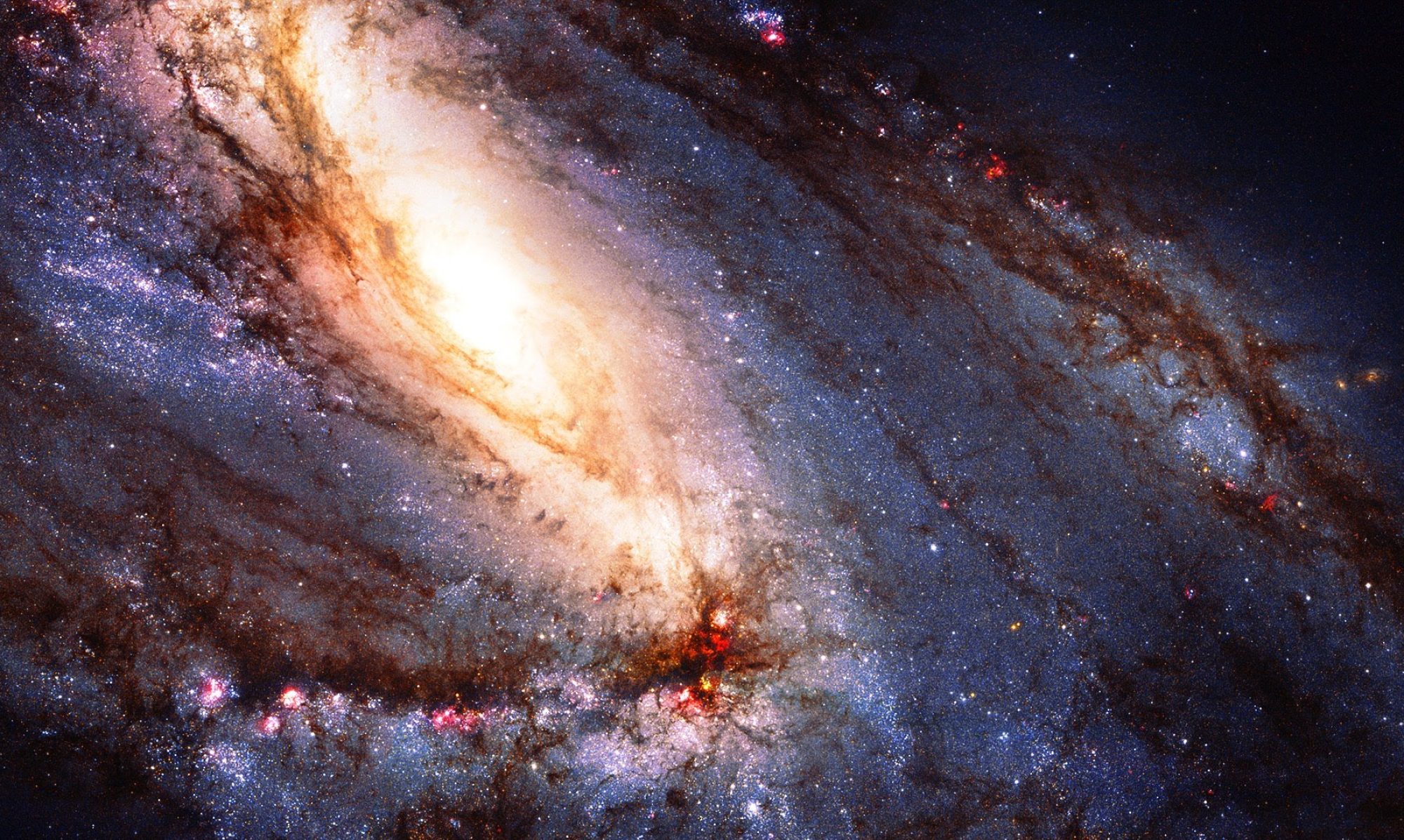
Apart from the obligatory nod to the prevailing local deity at the time that this was written, that is exactly where we came from – and, of course – where we still are! The  cosmic womb that spawned us,  and that continues to nurture us! And so let’s focus for a moment on the ongoing scientific effort to probe the heavens – our heavenly home – with the hope of finding out more about its origin and scope – such as how all of this might have come about.

And as we continue to do so – by reaching out further and further into the depths of the physical universe with VLTs (Very Large Telescopes) – whatever we want to conclude about our cosmic environment becomes less and less intelligible the further we move away from earth. And here I couldn’t agree more with what was once said  by Pierre Teilhard de Chardin, a Jesuit paleontologist, in 1923  in Letters from a Traveler “The more remote in time and space is the world we confront, the less it exists, and hence the more barren and poorer it is for our thoughts”.

Ask yourself this: how meaningful is the recent discovery of the oldest galaxy ever observed by the Hubble telescope: “It is thought the galaxy is more than 13 billion years old and existed 480 million years after the Big Bang.”

Or: “Astronomers have spotted the most distant object yet confirmed in the universe – a self-destructing star that exploded 13.1 billion light years from Earth. It detonated just 630 million years after the big bang, around the end of the cosmic “dark ages”, when the first stars and galaxies were lighting up space”.

Apart from the “wow!” factor, this kind of information says more about the technology that made these discoveries possible than the actual objects themselves. While we may be able to express these observations in a manner that suggests that we actually know what we are talking about, we have clearly no concept of what this  means beyond building a theoretical model of our universe in which we appear to be just another speck of dust.

At most we can conclude is that an event is being played out here of cosmic dimensions, but also that – as unlikely as this may seem – this incredible spectacle is  directly relevant to us, as it pertains to both our origin, and our destiny. Yes, gentle reader, all this cosmic commotion is about you, regardless of whether you want to accept that or not.

I want to suggest that we can talk about the cosmos in a more meaningful fashion, by accepting all of it as another dimension of ourselves.  And here I am not talking  about some  esoteric physical and (above all) theoretical dimension requiring a succession of half-a-dozen blackboards to get spelled out, and meaningful only to some other theoretical physicist working within the same Kuhnian paradigm. With due respect, no.  I want to suggest an aspect of the cosmos that connects every particle internally regardless of where it is located – or how it is configured – and constitutes its integrity as an phenomenon in all its perplexing detail.

And while we do not know or understand much or any of it, it is an intrinsic part of our own existence, meaning that the key to all its magical and mysterious secrets lies not out there in some distant and abstract corner of outer space, but within ourselves. We embody all of this within the entity that we are: its origin, its history, its present scope, and its destiny.

Much of our scientific probing of outer space reminds me of a cat that got itself locked in a closet, scratching around in the dark trying to find a way out.  But we’re not trapped here, in the sense of being an isolated event in the cosmos: we are an event of the cosmos, and so  we don’t need to find a way out, we’re home safe and sound!

And so I am suggesting the possibility that, on the evolutionary front, we are its leading event – with the history of all that preceded us behind us, and a future in front of us to decide and create!  With the arrival  of our species  – Homo Faber –  the spectacular creativity power inherent in the evolutionary process that brought us about is now able to work directly through us for whatever goals we set for ourselves now or in the future!

I have been led to conclude that, if the cosmos is about anything at all, its agenda is about reinventing itself as a new entity, by turning itself inside out – so to speak – through the process of evolution, and reconstituting  itself as the sum of all the power and creativity that it is capable of.  You could say that it is a question of “rising to the occasion”, and as participants in this process this is something that we are all challenged with on a daily basis: we all have the same agenda, namely to make something of ourselves that captures our true potential.

And so we, the simple creatures of the earth, are finding ourselves at the top of creation as defined by our emerging consciousness, to be challenged to look deeper within ourselves to enable our own advancement as a species, to be more creative, more empowered, and to be more enlightened to take on our fate as an agent of evolution.

Presumably, all this to bring about a better world while seemingly still  preoccupied by the instincts of the  predatory animal that once preceded us – but in many way is still within us –  as evidenced by the dystopia we’re stumbling around in today and which appears to be entirely of our own making.

The Human Body is Largely not Human

This was a headline in the Scientist of June 13, 2012. The corresponding article by Ed Young based on The Human Microbiome Project Consortium, Structure, function and diversity of the healthy human microbiome (Nature, 486: 207-214, 2012) went on as follows:

The human body is largely not human. It contains trillions of microbes that outnumber our own cells 10 to 1, affecting our health and behavior. Now, an international consortium of around 200 scientists has mapped this diverse microbial community at an unprecedented level of detail, and shown just how much it varies from person to person.

Presumably, the main surprise was how these massive bug populations vary in makeup between individuals, while by and large fulfilling the same tasks for each person:

In cataloguing the healthy human microbiome, the HMP (Human Microbiome Project) has already yielded some surprises. For example, although each body part is characterised by some signature microbial groups, no species was universally present across every volunteer …

For me – if these observations shows us anything – it is the incredible creativity within the evolutionary process to make things work at the living organism level, as well as the symbiotic nature of life, i.e., no life-form is independent from some other form of life.

And as well as we might be able to catalog life by means of discerning distinct or discrete entities, in the end all life is as one and the living entity that is our planet Earth.

Creatures Made Of Stardust

This realization strikes me every so often, and continues to fill me with awe: as this is what we are in the larger scale of things, in addition to being a creature made of flesh and blood here on earth! You just have to step back a bit to realize this, but when I look up to see the stars at night, I know we are made from the same magical stuff , and that we are related – In fact, these stars are our ancestors!

This also tells me that I relate to them not only as just another instance of cosmic being, but also as an instance of cosmic evolution the purpose of which is not yet understood.

But  how do you reconcile the existence of the most distant star with our own existence, when we’re essentially made of the same stuff – stardust – yet cannot begin to explain why either exists in the first place?

Which brings me once again to my favorite subject: where is evolution taking us? Already, from stellar dust to the present day human being – we have been on quite a journey!

Are we there yet?  I don’t think so … because we will know when we get there.  My worry is, we have so much further to go on the evolutionary plane,  we will get lost a million times before we will have even an inkling in which direction we should be heading.  In the meantime, we appear to be little more than a pathetic collection of lost souls as evidenced by the content of the world news media every day.

Getting Organized for the Future

You would think that – if life is inherent in matter – and evolution drives the process of reaching ever higher levels of organizational complexity within it, there would be a continuation of this process in the collective consciousness that was brought about as a result of it.

And indeed, if you look at the various forms of human organization that we are familiar with today – and consider something as complex as a modern democratic nation state – its successful functioning depends entirely on the organizational capacity of its people to integrate its many socioeconomic, moral-legal, cultural and political dimensions into a stable entity that is able to persist over a long period of time.

In the end, we can see a world order that exemplifies this principle to the extent that individual abilities are maximized for everyone in the interest of the self and the larger good, and that should mean we are no longer a threat to ourselves or the planet we depend on for our continued survival and well-being.

Then, we will be ready for the next phase of cosmic evolution, whatever that may be.

Creatures of Flesh and Blood

The Human Body
The Human Body

So, yes, that is what we are, basically – but am I alone in thinking that this is little more than arrangement that happens to work for the moment, insofar this appears to be a somewhat hastily coddled together assembly of organs and bodily functions designed to last only for a period of time after which it will gradually disintegrate and plow itself back into the fertile ground that it originated from – a clear case of built-in obsolescence, if you ask me – but not after having had an opportunity to replicate itself. And what a clever way to ensure successive iterations of the human creature will have an opportunity to evolve as necessary in response to the ever changing conditions on mother earth.

Looking at the human body in detail, one has to be impressed at the incredible complexity of this arrangement, yet at the same time get a sense of looking at an ad hoc composition of sorts to make things work – or: how to do things the hard way, and all this to accomplish what? The capacity for conscious, reflective thought: I think, therefore I am – but for what reason?

And if anything should come to mind about this, wouldn’t it be the tremendous evolutionary pressure behind the event of  bringing us about,  as well as for us to justify the incredible creative effort that has gone into this process? I think so, but given the history of the human race to date, it might well take us countless millennia to make something of it – whatever that might look like. I have no idea.

Leave Your Brain At Home When You Go To Church

In 1962 –  not really all that long ago –  the Holy Office of the Roman Catholic Church issued the following monitum – or reprimand – regarding the writings of Pierre Teilhard de Chardin, (1881-1955), a French Jesuit priest who trained as a paleontologist and geologist and took part in the discovery of Peking Man during his nearly 20 years of research in China.

The above-mentioned works abound in such ambiguities and indeed even serious errors, as to offend Catholic doctrine… For this reason, the most eminent and most revered Fathers of the Holy Office exhort all Ordinaries as well as the superiors of Religious institutes, rectors of seminaries and presidents of universities, effectively to protect the minds, particularly of the youth, against the dangers presented by the works of Fr. Teilhard de Chardin and of his followers.

You see – like Copernicus before him – de Chardin had drawn conclusions about the world that were contrary to religious doctrine. As a trained scientist, as well as a gifted and original thinker, he could simply not accept the ancient folklore around the world’s creation in Genesis – and hence the concept of Original Sin. His evolutionary account of the origin of man as laid out in his most famous book Le Phénomène Humain (The Phenomenon of Man) written before 1940 had to be published posthumously in 1955 because the RC Church did not allow this during his lifetime.

In The Phenomenon of Man, de Chardin attempts to reconcile his faith with the unfolding of the material universe, from the earliest development of life to the presence of human beings, the parallel ascent of consciousness, and to his concept of the Omega Point in the future, the ultimate development of conscious life and convergence with God.

For him, evolution is an intrinsic, teleological or goal-driven process, proceeding from the most elementary particle in the cosmos to the most complex arrangements of matter, capable of ever higher levels of consciousness.

Clearly, Roman Catholic fundamentalism could not accommodate any of this.  It is –and always will remain – in the Dark Ages; its archaic, naïve doctrines seemingly frozen in time, not subject to reinterpretation or revision.  Not then, and especially not now, with with an ultra-conservative patriarchal throwback like Josef Ratzinger at the top of the hierarchy that controls the RC church today: Original thinking is an Original Sin!

Just so you know:  leave your brain at home when you go to church!

… the essence of Christianity, the typical Christian condition, ‘faith’, has to be a form of sickness, every straightforward, honest, scientific road to knowledge has to be repudiated by the Church as a forbidden road. Even to doubt is a sin … (Nietzsche)

Creationism and other Bedtime Stories

Over the years I have watched – somewhat bemused, I must admit – the ongoing debate between the proponents of the theory of evolution and those who hold that everything that exists today is the instantaneous product of an act of creation by something or another, typically a super natural being of sorts (I have no idea what that means – and those that believe this don’t know what that means either, although they would say that they do – but as they are unable to demonstrate in any form shape or fashion what it is that they are talking about, it comes down to a leap of faith in the end, and that seems to be the full extent of it. )

This debate is really about the distinction between theory and fantasy – between a descriptive account attempting to relate certain aspects of our observations of the physical world in some coherent and logical fashion, and a fantastic tale pulled out of a hat, a superstition gone rampant, folklore of the most primitive kind, and at best a naive belief in the order of a bedtime story for those who really don’t want to think about such things …

The premise of evolution is that – as a process – it can be applied consistently to give an account of a range of observations related to such things as the fossil record and the development of species. It describes the development of organic life over time, and draws conclusion about the process that underlies it in a compelling manner. It follows observation, not faith, and as such it is – as a theory – subject to continuous revision and refinement, and has stood up well over time. It is plausible account of some intrinsic biological process that brought us here as a distinct species, regardless of the question as to why we are here. Those are different issues. Evolution does not explain itself – why it is present in the first place – what motivates it – or what its aims are. But just because it cannot account for itself in these terms does not invalidate its application to the observable world – it simply is, like the world is – and everything in it. As such it does not remove the mystery of the world – that is not the function of the theory of evolution, and it can no more account for that aspect of existence than the childish claims of creationism.

If creationism can be accused of anything – other than making up stories – it is intellectual dishonesty. Someone might well be a creationist while basing their entire lives on the principles of scientific methodology – that is to say, everything they do or say is a function of astute observation and sound reasoning , of reaching conclusions based on cause and effect, and the subsequent predictability of events. This is how they plan their  daily routines, their economic decision, their careers, their lives .

In that context, creationists  are thoughtful,  rational people. Yet, they abandon all of that when it comes to considering the larger context for this and accept some naive and simplistic account in the order of a  fairy-tale that is entirely without merit..

This as opposed to examining the process that brought us here with the same intellectual tools that they apply to their daily lives.  To adopt the latter approach makes one look at the world with eyes wide open in absolute wonder and – to my mind – enhancing the miracle of the universe infinitely more than reducing it to some magical act by mystical beings.

The Cosmos Explained – Well, Maybe …

There is a scene in the movie Terminator 2, where the next generation terminator – who had morphed himself into a cop – is frozen solid after a tanker truck filled with liquid nitrogen spills its load all over him. As a result, he breaks up and disintegrates into a thousand little pieces. But – through some miraculous technology – the little frozen pieces thaw out quickly and a bit like like liquid mercury – roll together back into a cohesive mass and eventually reconstitute the deadly cop/terminator who continues the pursuit of Terminator 1 and his young protégé.

What I want to take from the above episode is the fact that something with an incredible creative ability  was destroyed – either wilfully or by accident – is able to reconstitute itself; that it has this inherent ability.

So – taking this recovery model into an analogy – what if the origin of the cosmos was also a calamity (the “Big Bang” scenario), in which something was destroyed that has the ability recover, and which is now trying to reconstitute itself. This scenario would offer the picture that within each particle in the universe resides the capacity to assemble itself back into ever increasing levels of organizational complexity so that it can become whole once again and regain control of its being. In this process, it is able to morph into whatever shape it has access to given its current environment in order to regain its desired integrity. This would account for all the creativity, drive and determination that evolution continues to demonstrate.

Pure speculation, I’m sure.

The Evolution of the Global Mind

Is the Cosmos here for us, or are we here for the Cosmos?  Then again, it could be neither, or both, or we are just innocent bystanders, and a by-product – if not a casualty – of a cosmic cataclysm of unknown proportions; it origins unknown and its final outcome yet to be determined. Not knowing the greater scenario that is being played out here, it remains a challenge to assign ourselves some particular role in it and see if we are able to follow it along with some consistency, hoping all the while it isn’t – in Shakespeare’s Macbeth’s words: “a tale told by an idiot, full of sound and fury, and signifying absolutely nothing …”

In this role we are driven along an evolutionary path of unknown origins, taking us who knows where – and that leaves us to figure out for ourselves where we are heading to. And in light of the human and environmental wreckage we continue to leave in our wake  it would be difficult to accept that homo sapiens is at or near the pinnacle of evolution. We clearly still have some way to go if the roughly two thousand years of our recorded history are anything to go by; and not until such time we are no longer our own worst enemy in trying to move ourselves ahead from our troubled past. You have to believe in something like this if you think we can much better than that, even if all we have to show for to date is little more than a blood-stained past.

But setting aside our self-disgust for a moment, let us look at this again with a less jaundiced eye. The arrival of homo sapiens introduced a volatility and a riskiness to the world which could be indicative reaching a critical stage in the evolution of the world. That such risk-taking would be justified can be seen in the context of fending off entropy – at least here on earth, and for the time being  – should that be the ultimate fate of the universe. And thus there will be an urgency to the evolutionary thrust to get done what needs to get done before time runs out, and to take some risks along the way. A risk management process by any other name.

You see, something very unique and significant happened with the introduction of homo sapiens to the planet: homo faber – man, the toolmaker – arrived on the scene. And while hitherto the spectacular creativity demonstrated by evolution manifested itself only from the inside out – through the incredible diversity of life-forms encountered here on earth, from the simplest plants and smallest single cell organisms to the largest or most complex ones – through a human being the creative forces of evolution are for the very first time being applied externally. With our hands – and with the tools made by our hands – we are able to reshape matter directly, and through us the creativity pressure of evolution goes to work in a greatly accelerated fashion – if not at breakneck speed – to whatever end it needs to get to …

Initially with primitive stone axes, then forged iron implements, followed by mechanized devices, and eventually through the ability to derive electricity from material processes and the huge array of material resources extracted from the earth we have been creating things of unimaginable potential if their development continues at the current pace. Technology is the only area in which our species has made substantive and measurable progress since we first opened our eyes as a creature capable of  reflective thought – knowing that one knows – and we have done so in a hurry.

Most importantly, we have made significant advances in the area of information technology, such as the internet, to the point that all knowledge we have accumulated of the world can be shared instantly at any time and potentially from anywhere. As such we have gone beyond the layer of our planet’s biosphere to create a dynamic layer of knowledge which is about the world, and which belongs to the world. In a sense, this layer of knowledge functions as the conscious mind  of the world.

(Some philosophers such as Theilhard de Chardin have referred to this layer of knowledge as the “noösphere” – meaning “sphere of reason” – and after the geosphere and biosphere it would be the  next evolutionary geological layer in the life of the planet.)